A Tradition Rooted in Everyday Needs
Folk art emerged from ordinary labor long before it was separated from craft or labeled as art. Objects were created first to meet practical needs, such as storing food, preparing meals, dressing the body, or marking important moments. Decoration developed alongside function, not as an afterthought but as a natural extension of making something well.
Within villages and small towns, visual expression blended seamlessly with daily use. The same people who farmed, cooked, or raised children also carved, stitched, painted, and shaped objects for their households. This closeness between use and expression shaped the grounded, durable, and readable character of Russian folk art.
Functional Objects as Forms of Expression
Many objects now associated with folk art were once simple household necessities. Storage chests, spoons, bowls, plates, towels, shirts, boots, toys, and tools offered surfaces for decoration. Ornamentation did not aim to impress outsiders. Instead, it distinguished work objects from festive ones, marked personal or family ownership, and showed care invested in making.
Painted wooden items, embroidered garments, and decorated ceramics reveal how modest objects became carriers of style and identity. A repeated floral border, a spiral, or a line of geometric shapes could signal local taste and shared standards of balance. These details mattered because they reflected attention, patience, and belonging.
Rituals, Seasons, and Life Transitions
Ritual life was very important in the life of the people. It worked towards constructing this imaginary world. The changes of seasons, the cycles of agriculture, weddings, births, funerals, and lots of religious ceremonies were all represented in pictures. Some things were fabricated only for possible ceremonies, while others were altered in outlook so as to become suitable for religious object.
Various designs which were associated with reproductivity, protection, blessings and forms of blessings are repeated many times generationally. This is why the motifs on clothing also tend to occur around the edges of-necklines, sleeves and bottoms, which is at the right places representing some degree of vulnerability of the self or certain areas of the clothing. At the same time the same images are also used to make toys for children and other decorative objects for adult who are bolder and more abstract and over simplified on emotion and movemt rather than middle and artistic in thought of realism which causes the shades of colors and the sizes of the object to speak more to completeness of the form or emptiness of the object.
Community Exchange and Shared Knowledge
Folk art rarely developed in complete isolation. Trade routes, markets, seasonal migration, and marriage connected communities and facilitated exchange. A motif or technique might travel from one region to another, adapting to new materials or aesthetic preferences along the way.
Transmission depended largely on observation and shared practice. Children learned by watching adults, helping with small tasks, and repeating gestures over time. Through this process, they absorbed proportions, rhythms, and methods without formal instruction. This explains why styles remain consistent within regions while still allowing individual variation.
Hand Skills, Materials, and Learned Gestures
Manual skill sits at the heart of folk traditions. Techniques evolved slowly, shaped by experience and repetition rather than theory. Craftspeople relied on familiarity with materials and tools, adjusting methods through trial and error across generations.
Across Russia's vast territory, available materials varied greatly. Forested regions favored wood, agricultural areas produced linen and wool, while clay, birch bark, and metal appeared where local resources allowed. Each material influenced the shape, durability, and decorative approach of objects.
- Carved, engraved, painted, and turned wood
- Woven, cut, and stitched birch bark
- Woven, embroidered, and block-printed textiles
- Hand-shaped, fired, and painted clay
- Hammered, pierced, and enameled metal
Materials affected not only appearance but also use and care. Painted chests had to withstand travel and seasonal movement. Textiles needed to remain legible after repeated washing. Craftspeople adjusted pigments, varnishes, and dyes to extend an object's life and maintain clarity.
Learning Through Observation and Repetition
Training in folk crafts often began without explanation. A gesture was demonstrated, then repeated until it felt right. Errors became visible immediately, especially in geometric patterns where imbalance stands out. This method trained perception alongside manual skill.
Repetition also encouraged variation. Two people repeating the same motif never produced identical results. One might compress the pattern, another might leave more space. This flexibility allowed traditions to remain stable without becoming rigid.
Simple Tools and Practical Ingenuity
Tools were usually simple and locally made. Knives, chisels, needles, looms, carved stamps, and handmade brushes were common. Skill depended on understanding how materials responded to pressure, movement, and time.
A single motif might appear across different media. A floral design could be carved into wood, woven into fabric, printed with a block, or painted onto clay. Each medium imposed different limits, but the underlying logic of rhythm, symmetry, and clarity remained consistent.
Finishing as a Sign of Respect
Finishing was not merely decorative. It signaled seriousness and respect for both the object and its user. Sanding surfaces, sealing paint, reinforcing seams, and balancing colors took time but protected objects from wear.
This attention is visible in smooth painted finishes, carefully edged textiles, and well-sealed wooden surfaces. Even simple objects could be finely finished, increasing their durability and making them suitable for inheritance.
Symbols, Colors, and Motifs That Speak Without Words
Folk motifs form a visual vocabulary understood within a community. While meanings shift by region and context, the practice of communicating through images remains constant. Repetition reinforces memory and establishes rhythm.
Geometric shapes, stylized plants, birds, horses, suns, and trees appear frequently. These elements operate on multiple levels, serving decorative purposes while also carrying symbolic associations related to home, family, and continuity.
Protective Motifs and Signs of Fortune
Many motifs are linked to protection. Enclosing shapes such as diamonds, crosses, rosettes, and zigzag lines suggest symbolic barriers against misfortune. In clothing, these elements often appear near openings, reinforcing areas thought to be vulnerable.
Animals and birds also carry layered meanings. Horses may suggest strength, movement, or labor, while birds can imply connection between earth and sky. These images allowed wishes and beliefs to be expressed visually rather than verbally.
Color Systems and Strong Contrast
Color functions as a visual signal. Red appears frequently, associated with vitality, celebration, and visibility. White often serves as a base, linked to light and clarity. Black outlines and structures patterns, ensuring legibility from a distance.
Blues, greens, and gold tones depend on pigment availability and regional taste. Strong contrast between background and motif helps objects stand out and remain recognizable even after long use.
Narrative Images, From Prints to Toys
Beyond repeated motifs, folk art also includes narrative forms. Printed or painted images depict scenes of daily life, celebrations, humor, and moral lessons. Figures are stylized, gestures exaggerated, and meaning easily grasped.
Toys made of wood or clay function as miniature scenes. Musicians, riders, animals, and domestic figures reflect social roles and shared stories. Their simplified proportions prioritize presence and character over realism.
Social Identity and Local Belonging
Motifs and techniques communicate belonging. Within a village, embroidery styles, color choices, or decorative borders can indicate origin, family background, or social role. Visual language helps situate individuals within a shared framework.
This identity remains flexible. Migration, marriage, and trade introduce new influences. Motifs may simplify, palettes may shift, but the practice of using visual signs to express connection endures.
Regional Variation and Continuity Today
Russia's varied climates and landscapes shape its folk traditions. Materials, subjects, and color preferences differ widely, yet a shared logic of transmission persists. Regional identity reflects lived conditions rather than decorative trends.
Folk art responds to how people build homes, dress for climate, store food, and move across territory. Objects carry memory of place while adapting to changing circumstances.
Northern Forests, Birch Bark, and Wood Carving
In northern forest regions, wood plays a central role. Carving, engraving, and assembling wooden objects suited storage, transport, and daily use. Natural grain and texture become part of the visual effect.
Birch bark, both flexible and durable, was used for baskets, boxes, and containers. Decoration follows the material's natural lines, resulting in restrained yet graphic designs shaped by function.
Central Regions, Decorative Painting, and Ceramics
In central regions, decorative painting flourished on household items such as trays, boxes, and furniture. Stylized flowers, leaves, berries, and birds appear in balanced but expressive compositions that reveal the maker's hand.
Painted ceramics also occupy an important place. Simple forms gain character through decoration. Whether using cool blue-and-white palettes or warmer tones, these objects emphasize clarity and repetition, making them immediately recognizable.
The Role of Folk Art in Cultural Memory and Education
Russian folk art has long functioned as a form of cultural memory, preserving knowledge that was rarely written down. Techniques, motifs, and visual conventions carried information about how to live in a specific place, how to relate to others, and how to mark important moments in life. Through repeated forms and familiar symbols, people learned not only how to make objects, but also how to understand their role within a community.
This educational role began early. Children encountered folk art in their homes through clothing, utensils, toys, and decorations. By handling these objects, they absorbed ideas about order, care, and continuity. A painted chest or embroidered towel taught more than a technique; it showed what was valued and respected. Over time, these visual cues shaped shared expectations about beauty, behavior, and responsibility.
Folk Art in the Modern World: Adaptation Without Loss
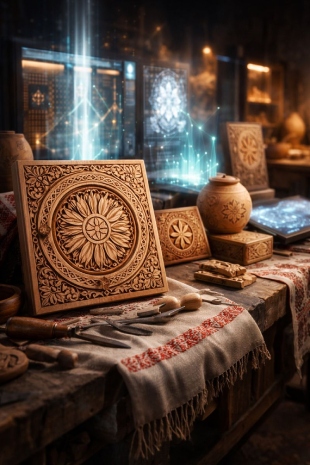
Russian folklore art being like woven together with digital realm, sigila makes a stark contrast with its surroundings with the new era, and yet persists without losing its importance, but instead evolving to the new changing patterns within which it function.
Nowadays even if the craftsmen have left the traditional 'village' way of life, they still often share the same attitude of repetition, focus on 'raw' materials as a source of artistic inspiration and clear symbolism common in the earlier traditions.
Some times there are initiatives to inter prices the designs in that they would simplify the motifs or change the color combinations of the images do to changing tastes and new applications. Motifs related to national folklore can be encountered in such spheres as clothing, interior design, illustration and even educational materials.
This is a constructive approach which suitably and thoroughly changes the essence of the elements of the tradition without erasing a worn out traditional dress, which is the most effective way of making these design elements remain helpful and relevant.
Against this backdrop, an approaching dialogue seeks to maintain what is in the best condition. Focusing on workshops, local studios, and cultural programs helps in the examination of traditional services and the support of high-level professionals. It is an awareness that such a way of folk art can be hardly preserved. In order to wear something such as this, one must constantly change, but in the end, the wear must be one that relates to excasitsting forms while being deprived of any respectfulness to it.
When Objects Communicate More Than They Show
Russian folk art represents a continuous cultural practice grounded in gesture, material, and shared meaning. Emerging from everyday needs, it conveys skills, symbols, and regional identities through objects designed to last. Constantly reinterpreted, it remains a living visual language shaped by collective experience and intergenerational transmission.
This tradition endures not because it resists change, but because it absorbs it carefully. Each object carries both function and memory, linking past and present through forms that continue to be made, used, and understood.